Nvidia CEO Jensen Huang Resigns: What It Could Mean for NVDA Options Traders
 Published Nov 12, 2026
 Updated Nov 12, 2026
Nvidia CEO Jensen Huang resigned on November 12, 2026. The company's 8-K states that Huang resigned as President, Chief Executive Officer, and a member of the Board, effective immediately. This article covers what Nvidia disclosed, what outlets reported about the market reaction, and how the change could affect NVDA options pricing and risk/
What Nvidia Announced
Colette Kress, Executive Vice President and CFO, will serve as Interim CEO and keep her CFO role until a permanent successor is named. The board is starting a search and will consider internal and external candidates. The filing also covers a governance change: Harvey C. Jones was appointed the first-ever Chair of the Board.
What Was Reported Before The Announcement
Several outlets covered the lead-up. CBS News reported that the board had been preparing to oust Huang, a plan first reported by the Wall Street Journal. Variety reported that the board had earlier launched an independent investigation into Huang's relationship with an executive at a Chinese technology company, and that the stock had fallen to eight-month lows over national security concerns. These are media reports of allegations. Nvidia's filing does not describe the reasons in those terms.
How The Market Reacted
NVDA dropped more than 11% in pre-market trading on November 12 and was down 5% by early afternoon, according to the Los Angeles Times, which reported that shares had fallen by as much as 19% since Friday. The Hill reported the stock near $149 just after the open, down about 14%.
The timing adds a second catalyst. The Los Angeles Times noted the resignation came five days before Nvidia reports third-quarter earnings, so near-dated NVDA options are pricing both the leadership change and a scheduled earnings report.
Brian Colello, a senior equity analyst at Morningstar, told the Los Angeles Times the resignation was "absolutely stunning news" that "was not something that was on the minds of investors a week ago." He said Nvidia appeared to have done little succession planning, given how much of the company's leadership and decision-making centered on Huang.
How The Nvidia CEO Resignation Could Affect NVDA Options
A leadership change at a company with liquid options can affect several pricing inputs at once. Earnings arrive on a known date with a measurable history of post-report moves. A resignation has neither, so repricing happens all at once when the news breaks. The effects below describe general mechanics and do not predict direction or magnitude for NVDA.
Implied volatility
Implied volatility rises when the market prices a wider range of outcomes. Nvidia's board is only starting its search for a permanent CEO. Open items such as a successor and any legal or regulatory developments outlets have reported can keep uncertainty in option prices until they resolve. A hypothetical $100 stock with 50% annualized implied volatility has a one-day expected move of about $3.15 ($100 × 0.50 × √(1/252)). At 80% implied volatility, the expected move is about $5.04 ($100 × 0.80 × √(1/252)).
Term structure
Front-month options usually reprice more than back-month options when news is near-term and uncertain. That can flatten or invert the term structure, so near-dated options carry higher implied volatility than longer-dated ones.
Skew
Demand for downside protection can lift implied volatility on lower-strike puts relative to calls at the same expiration. The steepness of skew shows how much the market is paying for that protection.
Premiums and liquidity
Higher implied volatility raises option premiums across the chain. Bid/ask spreads can widen as market makers adjust for risk, which raises the cost of entering and exiting.
Post-event contraction
If uncertainty resolves, implied volatility can fall even when the stock does not move. That reduces the value of long options and benefits short options, subject to the stock's movement.
Position type | Effect of higher implied volatility | Primary risk |
|---|---|---|
Long call or put | Higher premium paid, higher breakeven | Premium can fall if IV contracts or the stock does not move enough |
Short option (undefined risk) | Larger credit received | Losses increase as the stock moves past breakeven and, for short calls, are not capped |
Defined-risk spread | Credit or debit adjusts to wider pricing | Max loss is capped: spread width minus the credit for credit spreads, or the debit paid for debit spreads |
Covered call | Higher call premium received | Upside is capped, and the shares still carry downside risk |
Position type | Effect of higher implied volatility |
|---|---|
Long call or put | Higher premium paid, higher breakeven |
Short option (undefined risk) | Larger credit received |
Defined-risk spread | Credit or debit adjusts to wider pricing |
Covered call | Higher call premium received |
Position type | Primary risk |
|---|---|
Long call or put | Premium can fall if IV contracts or the stock does not move enough |
Short option (undefined risk) | Losses increase as the stock moves past breakeven and, for short calls, are not capped |
Defined-risk spread | Max loss is capped: spread width minus the credit for credit spreads, or the debit paid for debit spreads |
Covered call | Upside is capped, and the shares still carry downside risk |
Viewing These Measures On The tastytrade Platform
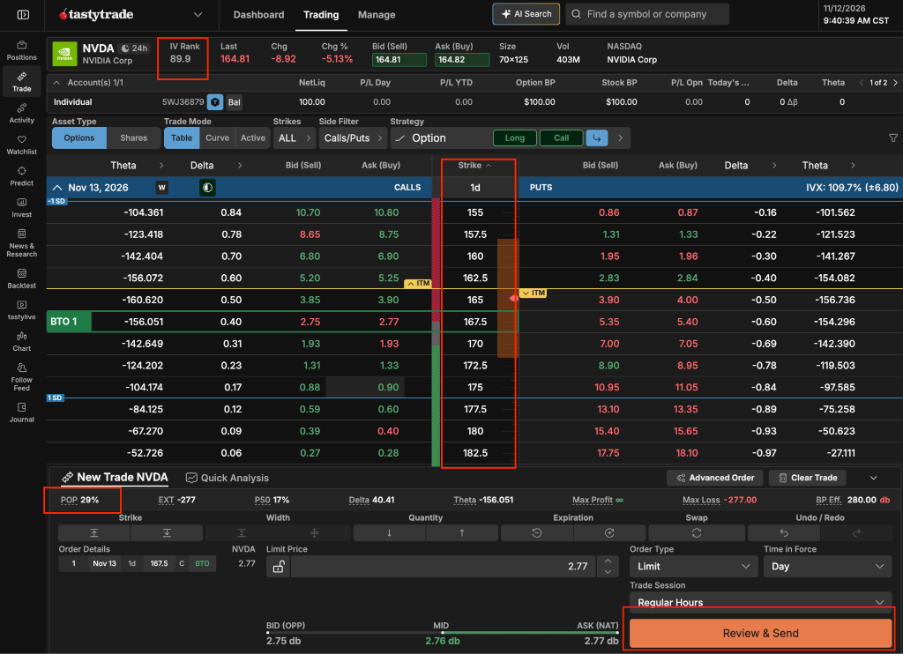
On the tastytrade desktop platform, the Trade tab in Table mode displays implied volatility and probability of profit for each strike, and Review & Send shows buying power effect before an order is submitted.
Review commissions & fees before placing any order. See the options trading page for the product overview, the trading platforms page for platform details, and the learn center for volatility background.
Risks During Event-Driven Periods
- Gap risk. Shares can open through a strike with no trade at the levels in between.
- Larger credit, same exposure. A short premium position that collects more credit because of higher implied volatility is also exposed to the larger moves that pricing reflects.
- Defined risk is not zero risk. Consider a hypothetical $5-wide short put spread opened for a $1.50 credit. Max profit is $150 per spread. Max loss is $350 per spread ($5.00 width minus $1.50 credit, times 100). Breakeven is the short strike minus $1.50. A gap below the long strike produces the full $350 loss.
Explore option chains on tastytrade
The naming of a permanent CEO, further company disclosures, and the next scheduled earnings report can each reprice options again, independent of the others.
Frequently Asked Questions
Colette Kress, Nvidia's Executive Vice President and CFO, became interim CEO on November 12, 2026. She keeps her CFO role until a permanent CEO is named, and the board is searching internally and externally.
Often, yes. A resignation adds uncertainty about strategy, succession, and potential legal or regulatory outcomes, which can widen the range of prices options traders expect. The size of the change depends on the company, the circumstances, and how much information is still pending.
Earnings occur on a scheduled date and have a measurable history of post-report moves. Event risk from unscheduled news has no known date and no comparable history, so implied volatility reprices all at once when the news breaks.
Implied volatility can contract, which lowers option premiums even if the stock price does not change. Whether this helps or hurts a position depends on whether the position is long or short volatility.
Options involve risk and are not suitable for all investors as the special risks inherent to options trading may expose investors to potentially significant losses. Please read Characteristics and Risks of Standardized Options before deciding to invest in options.
This content, including the use of actual symbols, any visual display or other reference to product, type of investment, strategy, or service offered, is for educational purposes only. It is not, nor is intended to be, trading or investment advice or a recommendation that any investment product or strategy is suitable for any person. You are solely responsible for making your own investment and trading decisions and for evaluating relevant factors, including their investment experience, objectives, financial situation, and risk tolerance prior to trading.About tastytrade
tastytrade is an award-winning brokerage firm established in 2017 to change the way people invest. tastytrade empowers investors seeking to actively manage their own money with a powerful platform and access to educational content for stocks, options, and futures trading. tastytrade is a subsidiary of IG US Holdings, Inc., parent to tastylive, the financial content and education platform; tastyfx, the fastest-growing forex broker in the United States; tasty Software Solutions, LLC; and a subsidiary of IG Group Holdings plc (LON:IGG), a global fintech company that provides award-winning products, platforms, and access to ~21,000 financial markets to investors around the world. Learn more at www.tastytrade.com.
tastytrade, Inc. (“tastytrade”) is a registered broker-dealer and member of FINRA, NFA, and SIPC. tastytrade offers self-directed brokerage accounts to its customers, and does not give financial or investment advice, nor does it make trade recommendations. You alone are responsible for making your own investment and trading decisions and for evaluating the merits and risks associated with the use of tastytrade’s systems, services, or products.