How is Portfolio Margin Calculated?


Portfolio margin uses stress tests to estimate the largest theoretical one-day loss across a portfolio, then sets buying power requirements around that risk rather than fixed position-by-position formulas.
At tastytrade, eligible positions are stress tested across multiple price and implied volatility scenarios using a risk-based methodology tied to OCC TIMS.
This article explains how the risk array is built, how hedges and concentration change the requirement, and what the requirements are at tastytrade.
Key Takeaways
- The largest theoretical loss sets the core requirement. For stocks and stock options, the price range tested is generally about 15% in either direction.
- Hedges and offsets can lower the requirement. A protective put on long stock reduces the worst-case loss in the risk array. Diversification does not guarantee a lower requirement.
- Concentration and volatility can raise it. One underlying can dominate the stress test, and rising implied volatility can widen theoretical losses.
- Stocks, ETFs, stock and ETF options, and Treasuries can qualify. Futures, cryptocurrencies, and many less liquid products are subject to separate margin methodologies.
- tastytrade requires $125,000 to activate and $100,000 in equity to keep it active. Eligible accounts also need The Works trading permissions and approval for PM.
- Leverage can reach roughly 6.7:1 in certain circumstances, compared with 2:1 for stocks under Regulation T. Higher leverage magnifies losses, and requirements can rise quickly as risk changes.
What Does Portfolio Margin Measure?
Portfolio margin, or PM, measures the risk a trader takes across an entire portfolio.
Instead of assigning a fixed margin requirement to every position, portfolio margin considers how those positions might perform under different market conditions.
At tastytrade, that calculation uses a risk-based methodology built around the Options Clearing Corporation's Theoretical Intermarket Margining System, better known as TIMS. The idea is simple. The system:
- takes your positions
- runs them through a series of hypothetical market moves
- calculates how much the portfolio could theoretically lose in each scenario.
The largest projected loss helps determine how much buying power you need.
This matters with hedges in particular. If you own 100 shares of stock and buy a put to protect against a decline, you've reduced your downside exposure.
Portfolio margin can recognize that protection directly in the calculation.
Regulation T uses more standardized, strategy-based requirements that don't always capture those relationships the same way.
How Is the Portfolio Margin Risk Array Built?
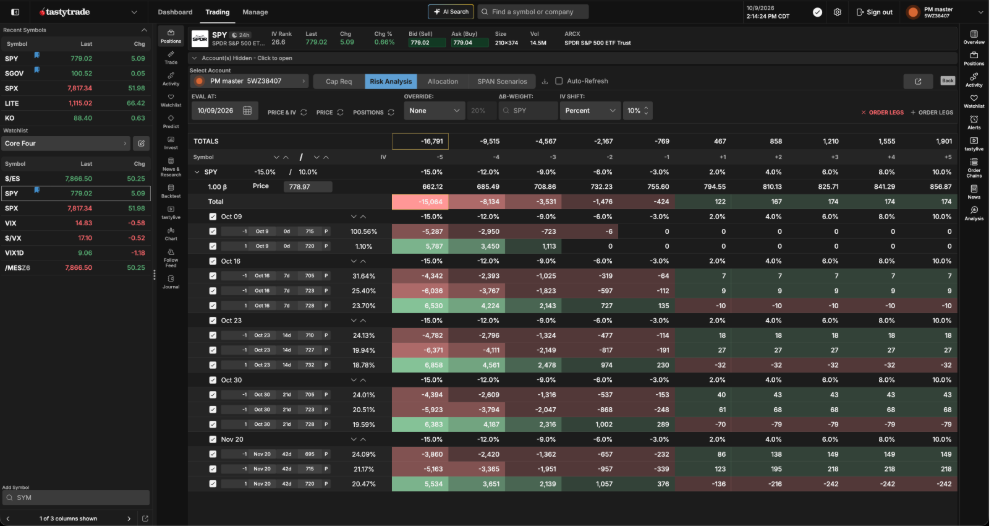
The risk array is the set of theoretical profit-and-loss results produced by testing a portfolio across price and implied-volatility scenarios.
For stocks and stock options, tastytrade generally starts by looking at what happens if the underlying moves about 15% in either direction. If a stock is trading at $100, we're talking about a range from roughly $85 to $115.
Within that range, the system tests multiple price points and calculates what each position would theoretically be worth.
And because we're dealing with options, there's another variable we have to account for: implied volatility.
An option's value can change even if the underlying price doesn't move very much.
So the model also incorporates changes in implied volatility when it evaluates the position.
Each price-volatility combination produces a theoretical profit or loss.
Collectively, those results make up what's called the “risk array”. The system identifies the scenario with the largest projected loss and uses that as the starting point for the margin requirement.
How Does a Portfolio Margin Calculation Work in Practice?
Assume a stock trades at $100 and a trader owns a hedged options position. The PM system tests the position across a range of hypothetical prices, including moves toward $85 and $115, while also changing implied volatility.
In one scenario, the position may lose $1,200. Another may show a $1,650 loss. A third may produce a $900 gain.
Scenario | Theoretical result |
|---|---|
Scenario A | -$1200 |
Scenario B | -$1,650 |
Scenario C | +$900 |
Scenario | Theoretical result |
|---|---|
Scenario A | -$1200 |
Scenario B | -$1,650 |
Scenario C | +$900 |
If $1,650 is the largest theoretical loss across the required scenarios, that loss becomes the core buying power requirement for the position before additional house rules, or offsets, are applied.
If a long option reduces the worst-case loss to $950, portfolio margin can recognize that hedge because the new risk array shows less theoretical loss.
How Do Offsets and Diversification Affect Portfolio Margin?
Portfolio margin can lower a requirement when positions offset one another, and spreading risk across underlyings can limit the impact of any single position. The clearest offset is a hedge in the same underlying. If you are long stock and own protective puts, the system accounts for the downside protection those puts provide. The methodology can also recognize certain offsets between eligible products, depending on how those positions are treated under the margin framework.
At tastytrade, stocks, ETFs, stock and ETF options, and Treasuries can qualify for portfolio margin treatment. Futures, cryptocurrencies, and many less liquid products are subject to separate margin methodologies.
Diversification does not guarantee a lower requirement. The relationships between positions, their eligibility for offsets, and the applicable stress scenarios determine the actual calculation.
Why Can Concentration Increase the Portfolio Margin Requirement?
Concentration increases the requirement because one underlying can dominate the stress test and drive the largest theoretical loss. When risk is spread across different underlyings, the portfolio depends less on any single position. When one stock or ETF represents a disproportionate share of exposure, the worst-case scenario in the risk array is more likely to come from that position.
Rising implied volatility can have the same effect by widening the range of theoretical losses. A position that required less capital at entry can require more later as price, implied volatility, or concentration changes.
What Are the Portfolio Margin Requirements at tastytrade?
tastytrade requires $125,000 in the securities account to activate portfolio margin and at least $100,000 in securities-account equity to keep it active. Eligible accounts also need The Works trading permissions and approval for PM.
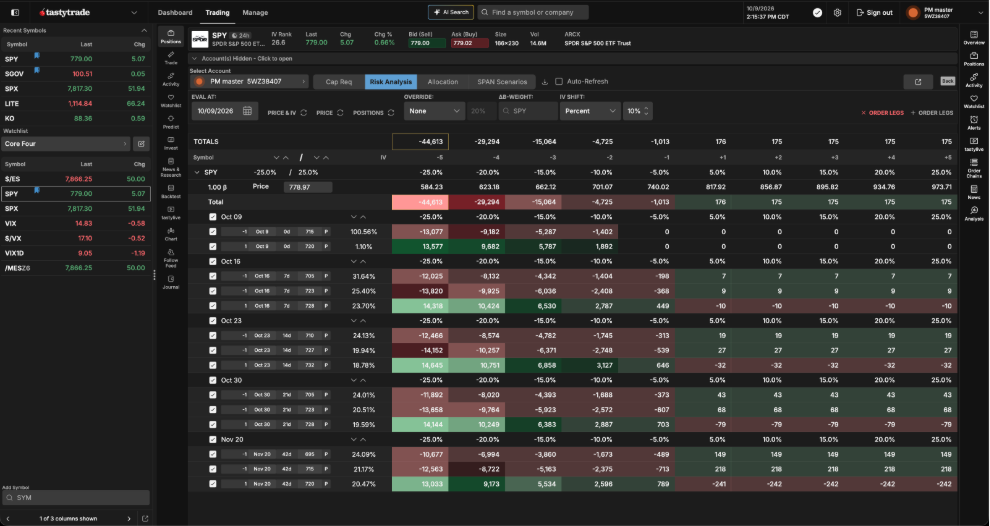
The platform's Risk Analysis tools allow traders to view the stress array before and after a position. That is useful because PM requirements are dynamic. A trade can reduce buying power when entered, then require more capital later if price, implied volatility, or concentration changes.
Portfolio margin can provide leverage of up to roughly 6.7:1 in certain circumstances, compared with the 2:1 stock leverage commonly associated with Regulation T. The benefit is capital efficiency. The tradeoff is that the required capital can change faster as the portfolio's risk changes.
Interesting In A Portfolio Margin Account?
Portfolio margin accounts require approval and are subject to minimum equity requirements. Traders who meet the eligibility criteria can open an account and apply for portfolio margin.
How Can Traders Monitor Portfolio Margin Requirements?
Traders can monitor portfolio margin by comparing the risk array before and after a trade and tracking remaining buying power. The notional size of a position only shows part of the picture. The more relevant measure is how the new position affects the portfolio under stress.
A monitoring routine typically includes:
- Comparing the existing risk array with the projected array after adding the trade
- Identifying which scenario produces the largest theoretical loss
- Reviewing how a change in implied volatility affects the result
- Checking whether one stock or ETF drives a disproportionate share of exposure
Buying power usage also matters. When a portfolio uses nearly all available buying power, a sudden rise in implied volatility or an adverse move in the underlying can put pressure on the account. The requirement can increase at the same time the positions lose value, and that can force a reduction in exposure while markets are moving against the account.
When positions offset one another effectively, the system can reflect that through lower capital requirements. When positions become more concentrated, or volatility raises the potential for losses, the system can require more capital.
Frequently Asked Questions
Portfolio margin at tastytrade is calculated by stress testing positions across a range of price and implied volatility scenarios using a risk-based methodology tied to OCC TIMS. For stocks and stock options, the price range is generally about 15% in either direction. The largest projected loss in the resulting risk array becomes the core margin requirement.
tastytrade requires $125,000 in the securities account to activate portfolio margin and at least $100,000 in securities account equity to keep it active. Eligible accounts also need The Works trading permissions and approval for PM.
Regulation T applies set requirements to each position or strategy. Portfolio margin stress tests the whole portfolio and uses the largest theoretical loss as the requirement, so hedges and offsets count. It can reach roughly 6.7:1 leverage in certain circumstances, versus 2:1 for stocks under Regulation T, and higher leverage magnifies losses and can quickly raise requirements.
Stocks, ETFs, stock and ETF options, and Treasuries can qualify for portfolio margin treatment at tastytrade. Futures, cryptocurrencies, and many low-liquidity products are subject to separate margin methodologies.
Yes. A portfolio margin requirement is dynamic. It can increase after a trade is placed if price, implied volatility, or concentration changes, even when no new positions are added.
Trading in a Portfolio Margin account is not suitable for all investors as the increased leverage can result in significant losses in the event of adverse market movements, up to or greater than the amount of your original investment. You are solely responsible for carefully considering the risks involved and determining whether trading in a Portfolio Margin account is appropriate for you based on your personal circumstances as the information presented does not take into account your particular investment experience or objective, financial condition, risk tolerance, or other considerations. Please read the Portfolio Margining Risk Disclosure Statement before determining if trading in a Portfolio Margin account is appropriate for you.
This content, including the use of actual symbols, any visual display or other reference to product, type of investment, strategy, or service offered, is for demonstrative and informational purposes only. It is not, nor is intended to be, trading or investment advice or a recommendation that any investment product or strategy is suitable for any person.