What is VIX Volatility Index and How Can You Trade It?


The VIX Volatility Index (Cboe Volatility Index) is widely used to measure expected stock market volatility and is often called the "fear gauge." This guide explains what the VIX measures, how it is calculated, what different VIX levels can signal about market sentiment, and how to trade the VIX using futures, options, and other volatility products at tastytrade.
What is VIX Volatility Index?
The Cboe Volatility Index (VIX) is a cash-settled index that represents the market’s expectations for S&P 500 Index (SPX) volatility. The VIX is derived from SPX options prices with near-term expiration dates, generating a 30-day forward-looking projection of implied volatility. Implied volatility, or how much a given trading product price is expected to change, is often seen to gauge market sentiment and the degree of fear among traders and investors. When the VIX is high, general market uncertainty is high, and investors should expect larger moves. When the VIX is low, complacency is high, and fear is low. One of the unique characteristics of the VIX is that it is a mean-reverting asset. Unlike equities that can stay above or below a mean price forever, the VIX rises above the mean and falls below the mean regularly. Because it’s an index that represents implied volatility, it ebbs and flows with market sentiment.
The index is more commonly known by its ticker symbol and is often referred to simply as “the VIX.” As it provides a quantifiable estimation of future market movement for a benchmark index like the S&P 500, it’s a valuable tool for both traders and investors alike to understand.
How Does the VIX (Volatility Index) Work?
The goal of the VIX is to measure the implied volatility of the S&P 500 on a 30-day forward-looking basis. When the VIX is above average, market volatility is typically more apparent than when the VIX is below average. The VIX is tradable via options, as it is a cash-settled index and does not settle to stock. Traders and investors can also participate in VIX futures contracts, volatility ETFs, and more.
In general, volatility can be measured using two different methods: historical and realized volatility, or implied or future volatility. Historical volatility tells us how a product has moved, and traders can build assumptions from that data.
The VIX is a measure of implied volatility, which involves using options prices to solve for future potential price movement in SPX. Option prices are a direct reflection of how wild a stock price is expected to move. The more expensive options are relative to the underlying price, the higher the implied volatility will be.
Since the possibility of such price moves happening within the given time frame is represented by the implied volatility, the Black-Scholes pricing model allows us to solve for implied volatility figures. Implied volatility is forward-looking, and certainly not guaranteed, as it ebbs and flows with options prices. This is how expected stock price ranges are derived over specific periods of time, even though implied volatility is traditionally presented on a one-standard-deviation, annual basis.
How to Trade the VIX
Understand What the VIX is and How It Works
What is VIX? It is the implied volatility gauge, often called the "fear gauge," for the S&P 500. Implied volatility is traditionally presented on a one-standard-deviation annual basis, but the VIX is presented on a 30-day forward-looking basis. The VIX is tradable directly using options strategies, as it is a cash-settled index.
Learn What Affects the Price of the VIX
The VIX is essentially a barometer for how expensive or cheap the options premium is within the S&P 500 index (SPX). This information is then used to determine market sentiment in the S&P 500. When markets are volatile, options prices can spike as more traders look to hedge against and speculate on big moves. When SPX options are expensive relative to the price of SPX, the VIX will have a higher reading than if markets are calm and SPX options are relatively cheap.
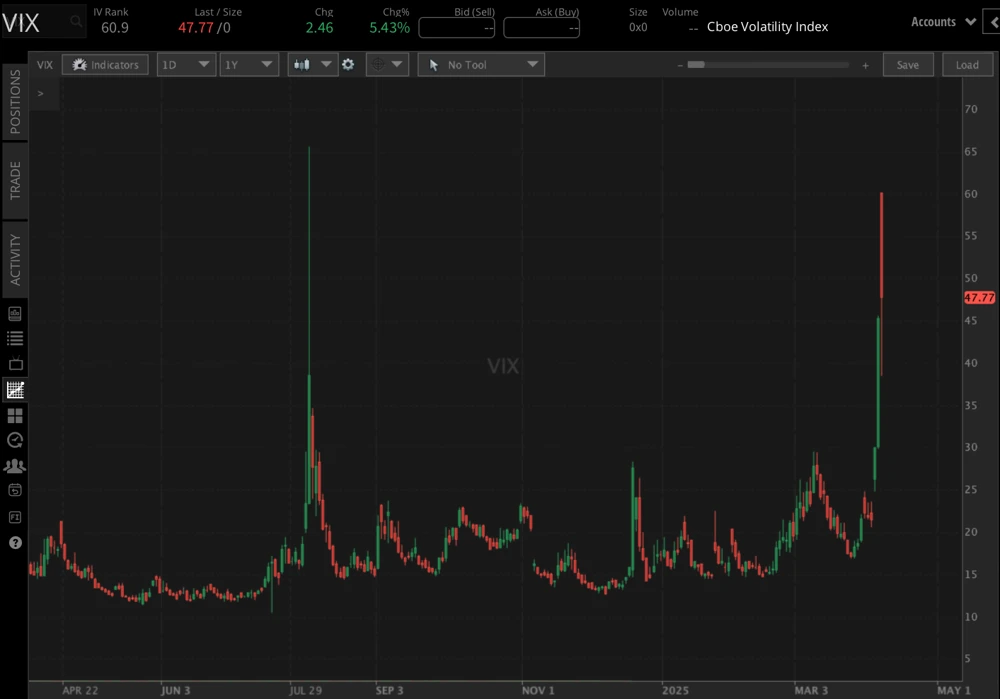
For context, the VIX has an average price in the teens over time. When markets react to uncertain times, the VIX can spike to much higher levels. During the mortgage crisis of 2008, the VIX spiked to over 80. During the COVID-19 lockdown in 2020, the VIX closed at an all-time high of 82.69. Be aware of the VIX price as you manage your portfolio, as it can be a telling sign of implied volatility or lack thereof.
Open a Trading Account
Open a tastytrade brokerage account to gain access to volatility trading products like the VIX, /VX futures, and more. The VIX can only be traded with options, so an account with options privileges would be required to trade the VIX.
The Market's Moving, Are You?
Select a Way to Trade the VIX
Before trading the VIX, it’s important to understand how the VIX options are priced, as they are unique and very different than regular equity options.
VIX Options
VIX options have different expirations, just like equity options. However, each VIX expiration is associated with a /VX futures contract with a similar expiration date. The futures contracts all have different prices, and this is especially apparent when markets are very volatile. Sometimes you can see a difference of a few or many points between one /VX futures contract and the next. The VIX will drift up or drag down in price over time, all else equal, to settle to the /VX futures contract price.
For example, if the VIX is trading at 20, but the /VX futures contract is trading at 25, the ATM options that are similarly priced in VIX will be around 25, even though the VIX is trading at 20. Because of this abnormality, VIX options can look weird visually, as the highest extrinsic value is not at the current price of the VIX – it's near the futures contract price. This is one of the main differences between VIX options and equity options, where equity options have the highest extrinsic value near the current stock price.
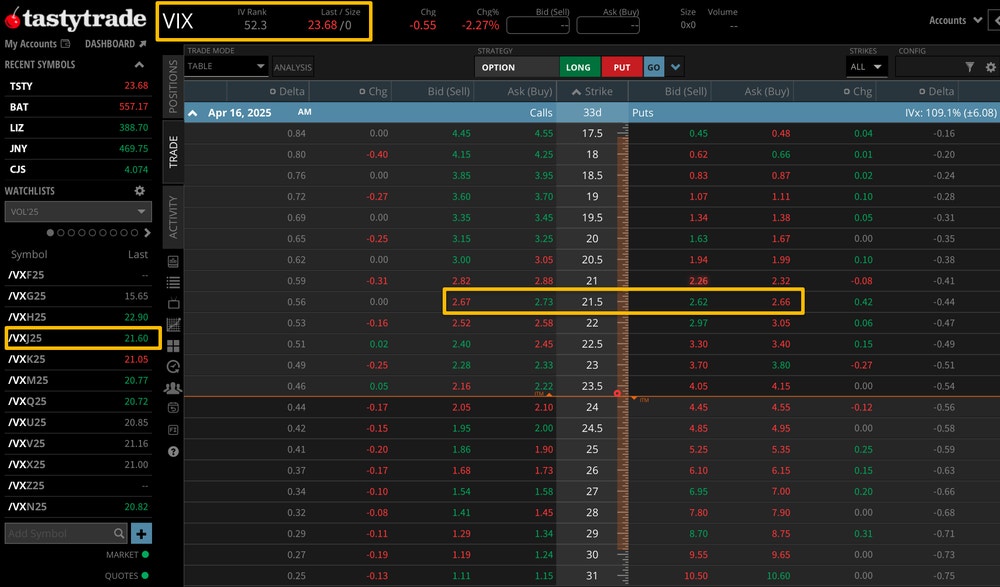
In the example above, we can see that the VIX is trading at 23.68, but the /VX futures contracts are trading around 21.5. The price point where puts and calls are trading for around the same value in VIX is near the 21.5 strike, instead of the spot price of 23.68. In other words, the VIX options look to the futures market for the underlying ATM price near the same expiration. All else equal, in this example, the VIX spot price will drag down towards 21.5 by the expiration date.
VIX Futures
If you’re looking for a cleaner way to trade S&P 500 volatility, VIX futures are an alternative. With that said, /VX futures contracts are significantly larger in size than VIX itself. Furthermore, there can be a huge divergence between one /VX futures contract and the next, so calendar spreads can be very risky in these products. Sticking to one futures contract expiration when trading futures will ensure that your notional value risk is bound to that contract in isolation. /VX futures are cash-settled products, which means the futures contract will eventually expire to cash instead of a physical product.
Open Your First Trade
Once you decide whether to trade the VIX, /VX futures, or another volatility product, it’s time to open your volatility trade. Using the tastytrade platform, you can use the bracket order system to set profit targets and stop loss thresholds with conditional orders, right from the beginning. Regardless of your trading instrument, be mindful of your risk, have a plan for exiting the trade, and understand that volatility products are...well...volatile.
Monitor and Close Your VIX Position
Once your VIX or /VX futures position is open, you’ll be able to manage it on your positions tab on the tastytrade platform. If you have a multi-leg options strategy, you can select each leg before closing or rolling the full position. You can also analyze the position or create a bracket order on your active position from the positions tab.
Learn more about managing your positions with tastytrade platform guides
VIX Trading Example
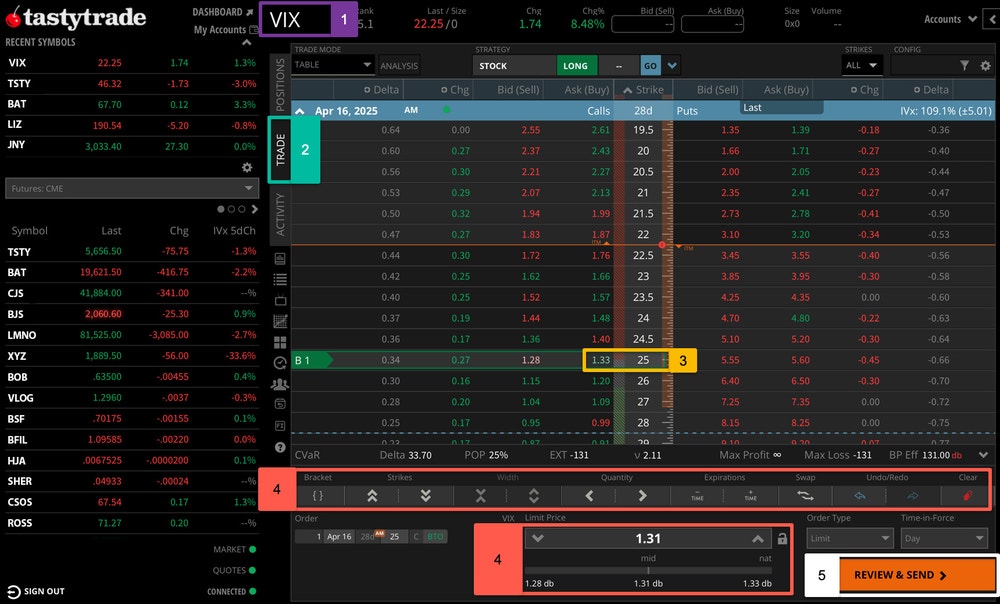
Log in to your web, mobile, or desktop tastytrade platform. In this example, we’ll look at buying a call option in the VIX on the tastytrade desktop platform.
- Enter VIX into the ticker symbol box along the top of the tastytrade platform.
- Click on the table trade view so you can see the options chain. This is where available options expirations are listed, and you can click into an expiration to see the call and put options.
- To buy or sell an option on tastytrade, click on the Bid (Sell) or Ask (Buy) next to the strike price of the call or put you want to trade. When you click on one of the prices, your VIX options trade will populate on the trade page. This example shows buying a 25-strike call option in VIX in the April expiration cycle.
- Along the bottom of the trade page, you adjust the quantity of options contracts, the purchase price, order type, and time-in-force (TIF) which is how long an order stays active before it expires. You can also move the strike up or down, adjust the expiration, and much more using this toolbar.
- Click the REVIEW & SEND button to review the trade details. On the final page, review all aspects of the order including commissions and fees and send the order.
FAQs
What is VIX? It measures the market's expected volatility for the S&P 500 over the next 30 days based on SPX options prices. A higher VIX generally signals greater expected market volatility and increased investor uncertainty, while a lower VIX suggests calmer market conditions and lower expected volatility.
The VIX is calculated using a wide range of near-term S&P 500 (SPX) call and put options prices. As expectations for future market volatility change, SPX options prices change, causing the VIX to rise or fall. VIX options are priced differently because they are based on VIX futures rather than the spot VIX index.
VIX options are based on the /VX futures contract with the expiration closest to the VIX option's expiration date. Because the VIX spot price and VIX futures price can differ, VIX options may not appear centered around the current VIX level like traditional equity options. As expiration approaches, the spot VIX and the corresponding VIX futures contract converge.
There is no fixed threshold for a "high" VIX, but readings above 30 are generally considered elevated and indicate increased expected market volatility. During periods of extreme market stress, such as the 2008 financial crisis and the COVID-19 market selloff, the VIX rose above 80. Lower readings typically reflect calmer market conditions.
A high VIX indicates that traders expect larger price swings in the S&P 500 over the next 30 days. Elevated VIX levels often occur during periods of market uncertainty when investors are buying options to hedge risk or speculate on increased volatility. While a high VIX reflects higher expected volatility, it does not predict the direction of the market.
Whether a high or low VIX is better depends on your investment or trading objectives. A lower VIX generally reflects calmer markets and lower expected volatility, while a higher VIX indicates greater uncertainty and larger potential price swings. Some traders prefer higher volatility because it can create more trading opportunities, while many long-term investors prefer more stable market conditions.
To trade VIX options, you need a brokerage account with options trading approval. Because VIX is a cash-settled index, its options are based on VIX futures rather than the spot index. Before trading VIX options, it's important to understand how they are priced and how they differ from traditional equity options. See the trading example above for a walkthrough of placing a VIX options trade on the tastytrade platform.
This content, including the use of actual symbols, any visual display or other reference to product, type of investment, strategy, or service offered, is for educational purposes only. It is not, nor is intended to be, trading or investment advice or a recommendation that any investment product or strategy is suitable for any person. You are solely responsible for making your own investment and trading decisions and for evaluating relevant factors, including their investment experience, objectives, financial situation, and risk tolerance prior to trading.
Options involve risk and are not suitable for all investors as the special risks inherent to options trading may expose investors to potentially significant losses. Please read Characteristics and Risks of Standardized Options before deciding to invest in options.
Multi-leg option strategies incur higher transaction costs as they involve multiple commission charges.