What Is a Naked Call?
 Published Sep 16, 2026
 Updated Sep 17, 2026
Selling a call without owning the underlying shares creates a defined premium and open-ended risk if the market rallies.
- A naked call sells a call option without owning the underlying shares or another position that fully covers the obligation.
- Maximum profit is limited to the premium received, while potential loss can keep growing as the underlying price rises.
- Strike selection, buying-power requirements, assignment risk and a predefined exit plan are central to managing the position
How a Naked Call Works
A naked call, also called an uncovered call, is created when a trader sells a call option without owning the underlying shares or another position that fully covers the obligation. The call buyer receives the right to buy the underlying at the strike price upon exercise. The call seller collects premium and takes on the obligation to deliver the shares if the option is assigned.
For a standard equity option, one contract represents 100 shares. If a trader sells one 110 call for $2.50, the position collects $250 before commissions and fees. That $250 is the maximum profit on the trade. The seller keeps all of it if the option expires worthless. If the stock finishes above the strike price, the call has intrinsic value and the short call begins to lose money.
The payoff is asymmetric. Profit is capped at the premium received, while the theoretical max loss is unlimited, because a stock has no fixed ceiling and can keep rising. That feature separates a naked call from a covered call, where the trader already owns shares that can be delivered if assigned.
Breakeven and Maximum Risk
The breakeven price for a naked call is the strike price plus the premium received. Using the same example, selling the 110 call for $2.50 creates a breakeven of $112.50 at expiration. Below $110, the trader keeps the full $250 credit. Between $110 and $112.50, part of the premium offsets the option's intrinsic value. Above $112.50, the position has a net loss.
Assume the stock settles at $130. The 110 call is worth $20, or $2,000 per contract. Subtract the $250 premium collected at entry and the loss is $1,750. If the stock settles at $150, the net loss grows to $3,750. The same formula continues as the stock rises.
That unlimited exposure to the upside is why naked calls require substantial buying power and why brokers may impose requirements above exchange minimums. A trader should know the firm's margin rules before entering the position because a large rally can increase both the option loss and the capital required to keep the trade open.
Assignment Changes the Position
Equity options are generally American-style, so they can be exercised before expiration. If a naked call is assigned, the seller is obligated to deliver 100 shares per contract at the strike price. A trader who does not already own those shares may end up short stock after assignment or may need to buy shares in the market to satisfy the delivery obligation, depending on the broker and account permissions.
Early assignment becomes more relevant when a call is deep in the money, has little remaining extrinsic value or sits near an ex-dividend date. The option price can still look manageable while the stock position created by assignment is much larger. Traders who sell uncovered calls should monitor expiration risk, dividend dates and remaining extrinsic value along with the option's mark price.
A Practical Trading Example
Assume a stock trades near $100 after a sharp rally. A trader believes the stock will remain below $110 over the next 31 days and sells the 110 call for $3.25. The trade starts with a $325 credit and a $113.25 breakeven at expiration.
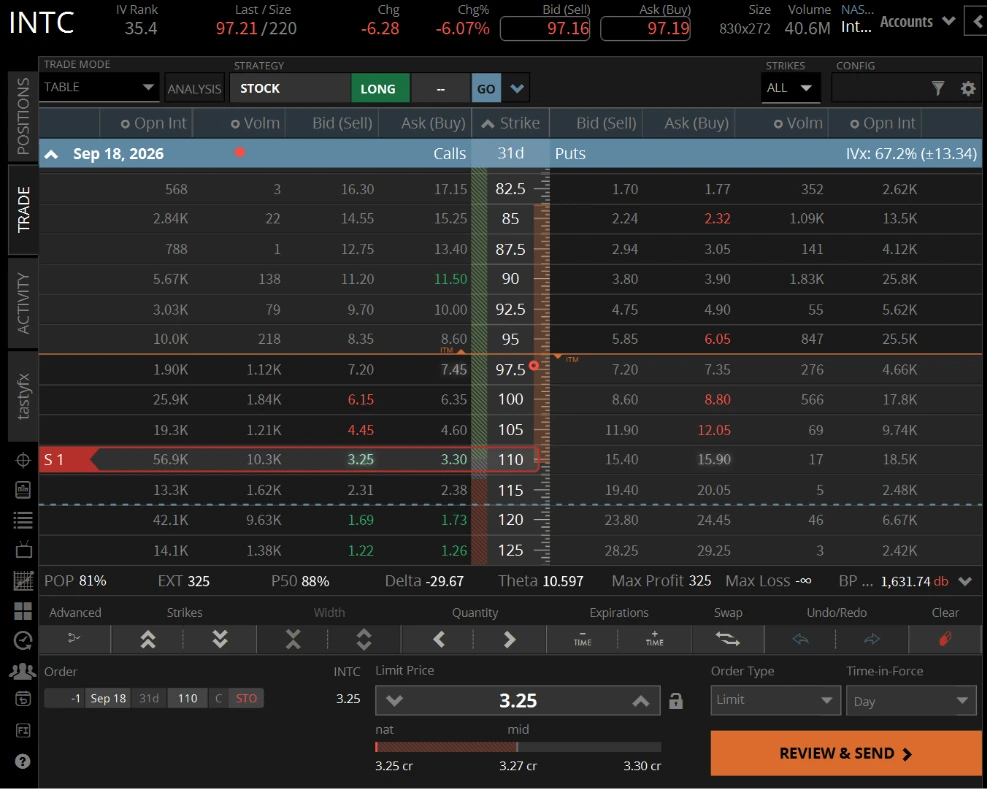
If the stock stays near $100 and implied volatility falls, the call may lose value. The trader could buy it back for $1.25, locking in $200 of profit without waiting for expiration. If the stock rallies to $108, the option may still be profitable, but the cushion has narrowed. If the stock breaks above $110 with momentum, the risk profile changes because every additional dollar in the stock eventually adds $100 of intrinsic exposure per contract at expiration.
A trader can respond by buying back the call, rolling it to another strike or expiration, or converting the position into a defined-risk spread by purchasing a higher-strike call. Each adjustment changes the economics. The key is to decide how the position will be managed before a rally forces the decision.
When Traders Use Naked Calls
Naked calls are usually used when a trader has a bearish or neutral outlook, believes implied volatility is rich, and wants to benefit from time decay. The position can work well when the stock stays below the strike and the option loses extrinsic value. It can become difficult when price and volatility rise together, since both forces can push the short call higher.
The trade is therefore less about predicting that a stock will collapse and more about controlling an asymmetric payoff. The premium is known at entry. The upside risk is not. Position size, strike selection and an exit plan determine whether the credit received is reasonable compensation for that exposure.
Frequently Asked Questions
This content, including the use of actual symbols, any visual display or other reference to product, type of investment, strategy, or service offered, is for educational and informational purposes only. It is not, nor is intended to be, trading or investment advice or a recommendation that any investment product or strategy is suitable for any person.