What is XRP (Ripple) & How Does it Work?


What is XRP? XRP is a digital asset created by Ripple Labs to facilitate fast, low-cost cross-border payments between financial institutions. As the native cryptocurrency of the XRP Ledger (XRPL), XRP is designed to enable fast and efficient value transfers. Known for its low fees and fast settlement times, XRP has become one of the world's largest cryptocurrencies by market capitalization. This guide explores how XRP works, its real-world use cases, how it compares with other cryptocurrencies, and how to trade XRP on tastytrade.
What is XRP?
XRP powers transactions on the XRP Ledger (XRPL), helping move value quickly and efficiently across borders. Traditional international payments can take several days to settle and often require multiple intermediaries, increasing costs and processing times. XRP was designed to address these challenges by enabling near instant transfers with minimal fees.
Unlike Bitcoin, which was created as a decentralized alternative to traditional banking, XRP was developed to improve existing payment infrastructure by helping financial institutions move money more efficiently.
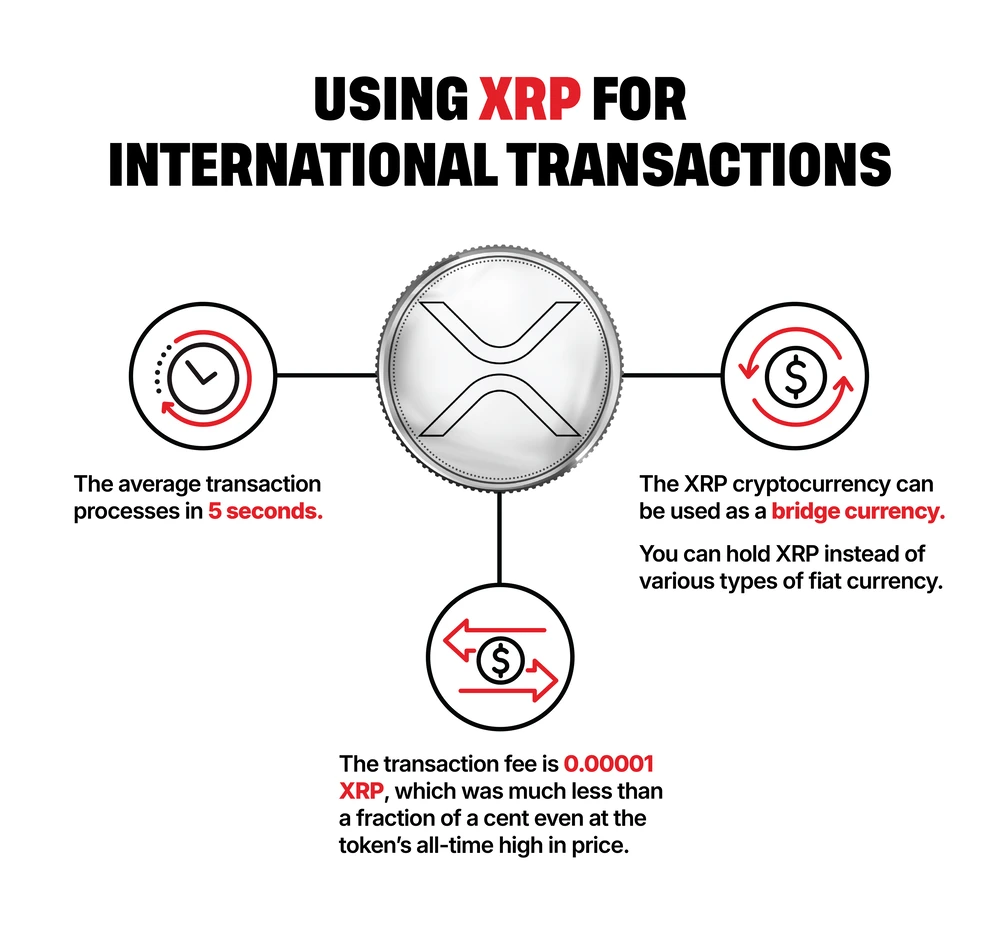
XRP transfers typically settle in 3–5 seconds, with minimal fees. This makes it one of the fastest crypto assets when it comes to settlement.
A Brief History of XRP
XRP launched in 2012, developed by engineers David Schwartz, Jed McCaleb, and Arthur Britto. The trio later co-founded Ripple Labs. The goal was to improve on Bitcoin’s limitations, particularly transaction speed and energy efficiency. XRP was designed with a fixed supply of 100 billion tokens, and unlike Bitcoin, it was not mined.
Ripple Labs became the main company supporting XRP’s ecosystem and promoting its use in financial institutions. The company created RippleNet, a network of partners using Ripple's payment technology. Some of these partners use XRP for on-demand liquidity.
XRP vs. Bitcoin: What's the Difference?
While both are cryptocurrencies, XRP and Bitcoin serve different purposes. Bitcoin is decentralized, mined, and widely viewed as a store of value. XRP, on the other hand, is built for speed and cost efficiency, often used to facilitate money transfers.
Feature | Bitcoin | XRP |
|---|---|---|
Purpose | Store of value | Global payments |
Consensus | Proof of work | Unique consensus |
Settlement time | ~10 minutes | ~3-5 seconds |
Energy use | High | Low |
Supply | 21 million | 100 billion |
Feature | Bitcoin |
|---|---|
Purpose | Store of value |
Consensus | Proof of work |
Settlement time | ~10 minutes |
Energy use | High |
Supply | 21 million |
Feature | XRP |
|---|---|
Purpose | Global payments |
Consensus | Unique consensus |
Settlement time | ~3-5 seconds |
Energy use | Low |
Supply | 100 billion |
Although XRP and Bitcoin are both cryptocurrencies, they were created with different goals. Bitcoin is primarily viewed as a decentralized store of value and relies on proof of work mining to secure its network. XRP focuses on enabling fast, low-cost payments through the XRP Ledger's consensus protocol, making it a more practical option for cross-border transactions.
How the XRP Ledger Works
The XRP Ledger (XRPL) is an open source blockchain that uses a consensus protocol, not mining, to validate transactions. Independent validators maintain the network, including universities, businesses, and individuals.
The XRP Ledger processes thousands of transactions per second with low fees, typically less than a penny. Because it uses a consensus protocol instead of mining, the network consumes significantly less energy than proof-of-work blockchains while maintaining fast transaction speeds.
Is XRP Decentralized?
This is a point of debate. Ripple Labs created XRP and still owns a large portion of its supply, which has led some to question the asset’s decentralization. However, the XRP Ledger is maintained by independent validators, many of whom are not affiliated with Ripple.
Over time, Ripple has reduced its control over which nodes validate transactions. Today, no single entity can alter the ledger without consensus from others on the network.
XRP Use Cases
XRP’s primary use case is facilitating fast, affordable cross-border payments. RippleNet uses XRP for on-demand liquidity (ODL), allowing institutions to move value across borders without the need to pre-fund accounts in different countries. This helps reduce settlement times, lower costs, and improve access to global liquidity.
Beyond cross-border payments, XRP also supports a growing range of applications on the XRP Ledger, including:
- Micropayments: Enables low-cost transactions for small payments that may not be practical with traditional payment systems.
- Remittances: Helps individuals and businesses send money internationally with faster settlement and lower fees.
- NFT settlement on XRPL: Supports the creation, transfer, and settlement of NFTs on the XRP Ledger.
- Institutional settlement: Enables businesses and financial institutions to transfer value more efficiently through blockchain technology.
XRP and the SEC Lawsuit Explained
In December 2020, the SEC filed a lawsuit against Ripple Labs, alleging that XRP was sold as an unregistered security. This sent shockwaves through the crypto industry.
In July 2023, a federal judge ruled that XRP is not a security when traded on public exchanges, offering partial legal clarity. However, the case remains ongoing with further court proceedings and appeals expected.
This legal backdrop has impacted exchange listings, partnerships, and U.S. market adoption. It also set an important precedent for how digital assets might be classified.
XRP’s Global Reach
Despite regulatory uncertainty in the U.S., XRP continues to gain traction abroad. Ripple has announced partnerships with financial institutions in regions like Asia, Latin America, and the Middle East.
Its fast settlement time and low cost make it attractive for markets with high remittance activity and limited access to traditional banking infrastructure.
How to Buy and Trade XRP
- Open a tastytrade account
- Enable cryptocurrency trading
- Select XRP from the crypto tab and open your first trade via Zero Hash
Ready to Trade?
Key Takeaways About XRP
- XRP is a digital asset optimized for fast, low-cost payments
- It runs on its own blockchain: the XRP Ledger (XRPL)
- Created by Ripple Labs to support global money movement
- XRP is not mined like Bitcoin and uses less energy
- Regulation and legal challenges have shaped XRP's public perception
FAQs
XRP is primarily used for fast, low-cost cross-border payments and liquidity. It also supports remittances, micropayments, and other applications on the XRP Ledger.
XRP transactions typically settle in 3 to 5 seconds, making XRP one of the fastest cryptocurrencies for transferring value.
No. Ripple is the technology company that helped develop the XRP Ledger and supports payment solutions, while XRP is the native cryptocurrency of the XRP Ledger used to transfer value and pay network transaction fees.
The regulatory status of XRP depends on the jurisdiction. In the United States, a 2023 federal court ruling found that XRP is not a security when sold on public cryptocurrency exchanges, although legal proceedings involving Ripple Labs have continued to shape the regulatory landscape.
The XRP Ledger is maintained by a distributed network of independent validators that use a consensus protocol to confirm transactions. While Ripple Labs remains closely associated with the XRP ecosystem and holds a significant amount of XRP, it does not unilaterally control the network.
Whether XRP is a good investment depends on your financial goals, investment horizon, and risk tolerance. Like other cryptocurrencies, XRP can experience significant price volatility, and past performance does not guarantee future results.
The XRP Ledger has operated since 2012 and is designed to securely process transactions through a decentralized network of validators. However, like any cryptocurrency, XRP carries investment risks, and the security of your holdings also depends on how they are stored and managed.
XRP is legal to own and trade in many countries, including the United States, although regulations vary by jurisdiction. Before buying or trading XRP, it's important to understand the laws and regulatory requirements that apply where you live.
Cryptocurrency trading provided by Zero Hash Liquidity Services LLC, MSB # 31000181510564, and cryptocurrency custody provided by Zero Hash LLC NMLS # 169937. Zero Hash is a licensed virtual currency business by the New York State Department of Financial Services. Cryptocurrency accounts are not protected by SIPC coverage. Cryptocurrencies are not covered by the FDIC, which covers fiat currency. Cryptocurrency trading is not suitable for all investors due to the number of risks involved, including volatile market prices, illiquid market conditions, lack of regulatory oversight, market manipulation, and other risks. You are solely responsible for evaluating your financial circumstances and determining whether or not trading cryptocurrencies is appropriate for you. Please read the General Risks of Digital Assets risk disclosure. tastytrade, Inc. is a separate company and is not an affiliate company of Zero Hash Liquidity Services LLC or Zero Hash LLC.