


Selling puts is a neutral-to-bullish options strategy where the seller collects a credit in exchange for the obligation to purchase 100 shares of stock at the strike price if assigned. The short put benefits from time decay and rising or stable underlying prices. This article covers mechanics, max profit and loss, breakeven calculation, cash-secured vs. naked put structures, when traders sell puts, and frequently asked questions.
What Is a Short Put?
A short put, also called a naked put, uncovered put, or bull put, is established by selling a put option to open a position. The seller receives the full premium of the contract upfront. In exchange, the seller takes on the obligation to buy 100 shares of the underlying at the strike price if the put buyer chooses to exercise.
The strategy is bullish to neutral. The seller does not need the underlying to rally to profit, they need it to stay above the short strike through expiration.
Understanding how puts work is a prerequisite before selling them. Put options give the buyer the right to sell 100 shares at the strike price. When you sell that right, you take the other side: the obligation to buy.
Short Put: Max Profit, Max Loss, and Breakeven
Metric | Formula | Example |
|---|---|---|
Max Profit | Cash received | $2.00 credit = $200 |
Max Loss | Strike price – Credit received (x100) | $50 strike – $2.00 = $48.00/share = $4,800 |
Breakeven at Expiration | Strike price – Credit received | $50 – $2.00 = $48.00 |
Buying Power Required (Cash) | Strike price x 100 | $50 strike = $5,000 |
Metric | Formula |
|---|---|
Max Profit | Cash received |
Max Loss | Strike price – Credit received (x100) |
Breakeven at Expiration | Strike price – Credit received |
Buying Power Required (Cash) | Strike price x 100 |
Metric | Example |
|---|---|
Max Profit | $2.00 credit = $200 |
Max Loss | $50 strike – $2.00 = $48.00/share = $4,800 |
Breakeven at Expiration | $50 – $2.00 = $48.00 |
Buying Power Required (Cash) | $50 strike = $5,000 |
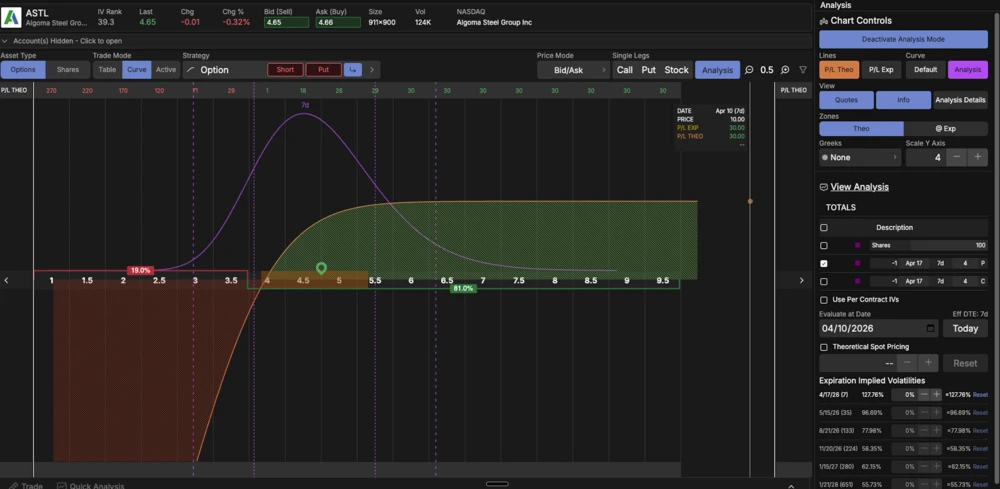
Max profit is capped at the credit received at trade entry. The put expires worthless if the underlying closes above the strike at expiration, and the seller keeps the full premium.
Max loss occurs if the underlying falls to zero. The short put seller is obligated to buy 100 shares at the strike price regardless of where the stock is trading. The credit received reduces the effective cost basis, but the loss potential is substantial. For a $50-strike short put sold for a $2.00 credit, the maximum loss is $4,800 per contract.
Breakeven is the strike price minus the credit received. In the example above, the position breaks even at $48.00. Any close above $48.00 at expiration yields a profit.
Naked Put vs. Cash-Secured Put
The short put strategy takes two different forms depending on account type and available capital.
Naked put (The Works and Basic trading level margin accounts): The buying power requirement is set by the broker's margin formula, typically a percentage of the notional value of the position. This is less than the full cash-secured requirement. Naked puts carry the same risk profile as cash-secured puts but require less capital to establish.
Cash-secured put (cash accounts, IRA accounts, and Limited trading level margin accounts): The account must hold the full notional value of the put contract as available options buying power. Selling a 50-strike put requires $5,000 of available cash ($50 strike x 100 multiplier). This structure requires more capital but is available in all account types at tastytrade.
Short puts are permitted in all tastytrade account types. The account type determines whether the put is treated as naked or cash-secured.
When Traders Sell Puts
Traders sell puts under specific market and volatility conditions.
Neutral to bullish directional bias. The short put profits when the underlying stays above the strike. It does not require a rally, only the absence of a significant decline.
Elevated implied volatility. Implied volatility inflates options prices. Selling puts when IV is elevated means collecting more premium for the same strike and expiration. When IV subsequently contracts, the position benefits from both theta decay and vega contraction.
Theta decay as a tailwind. The short put carries positive theta, meaning the position gains value with each passing day as the extrinsic value of the option erodes. This decay accelerates as expiration approaches, particularly for at-the-money options.
Willingness to own shares. Some traders sell cash-secured puts at strikes where they are comfortable owning the stock. If assigned, they acquire 100 shares at an effective cost basis equal to the strike minus the credit received.
Selling Puts vs. Buying Stock
Selling a put at a strike below the current stock price is often compared to buying shares outright. Both strategies are bullish, but they differ in several ways.
Short Put | Long Stock | |
|---|---|---|
Upside | Limited to credit received | Unlimited |
Downside | Strike – credit (substantial) | Full stock price (substantial) |
Breakeven | Strike – credit | Purchase price |
Income | Credit collected upfront | Dividends only |
Capital required | BP reduction (margin) or full cash (IRA/cash) | Full share price |
Short Put | |
|---|---|
Upside | Limited to credit received |
Downside | Strike – credit (substantial) |
Breakeven | Strike – credit |
Income | Credit collected upfront |
Capital required | BP reduction (margin) or full cash (IRA/cash) |
Long Stock | |
|---|---|
Upside | Unlimited |
Downside | Full stock price (substantial) |
Breakeven | Purchase price |
Income | Dividends only |
Capital required | Full share price |
Defined Risk Alternative: Short Put Vertical Spread
Traders who want to limit downside exposure can convert the naked short put into a short put vertical spread. This involves simultaneously buying a lower-strike put in the same expiration.
The long put acts as a hedge. Max loss is now defined: spread width minus the credit received, multiplied by 100. The trade-off is a reduced credit, since part of the premium collected funds the long put.
The short put reduces cost basis compared to buying stock at the current price. It also generates income even if the stock stays flat. The trade-off is capped upside, as the seller does not participate in a rally beyond the credit received.
Short Put | Short Put Vertical | |
|---|---|---|
Credit | Higher | Lower |
Max Loss | Substantial (strike – credit) | Defined (spread width – credit) |
BP Requirement | Higher | Lower (defined-risk reduction) |
Risk Type | Undefined | Defined |
Short Put | |
|---|---|
Credit | Higher |
Max Loss | Substantial (strike – credit) |
BP Requirement | Higher |
Risk Type | Undefined |
Short Put Vertical | |
|---|---|
Credit | Lower |
Max Loss | Defined (spread width – credit) |
BP Requirement | Lower (defined-risk reduction) |
Risk Type | Defined |
For accounts where buying power is a constraint, or for traders who prefer defined risk, the short put vertical is the more capital-efficient structure.
Short puts are not hold-to-expiration trades by default. Active management reduces risk and locks in profits before they erode.
Risk management: Some traders close short puts early based on the amount of time remaining until expiration, changes in implied volatility, or based on the underlying's price. Closing a short put early eliminates the risk of assignment and frees up buying power that was previously held as collateral.
Rolling the position: If the underlying declines toward the strike, one management approach is to roll the short put, which consists of buying back the current put and selling a new put at a lower strike and/or further expiration. Rolling can extend duration, collect additional premium, and move the strike away from the current stock price.
Assignment: If the put expires in-the-money by $0.01 or more, it is automatically exercised. The seller is assigned 100 long shares at the strike price. Plan for assignment in advance. If the account has sufficient equity to hold the shares, the assignment converts the position to a stock position at the effective cost basis.
Expiration risk: Short options carry after-hours risk on the day of expiration. Exercise and assignment can occur after the close if the underlying moves significantly. Traders who do not want to take assignment should close the position prior to expiration.
Short Put: Key Characteristics Summary
Characteristic | Detail |
|---|---|
Directional Bias | Neutral to bullish |
Risk | Undefined (substantial) |
Reward | Limited to credit received |
Positive (benefits from time decay) | |
Negative (benefits from IV contraction) | |
Account Types | All (cash-secured in IRA/cash; naked in margin) |
Max Profit Trigger | Underlying closes above strike at expiration |
Max Loss Trigger | Underlying falls significantly below strike |
Characteristic | Detail |
|---|---|
Directional Bias | Neutral to bullish |
Risk | Undefined (substantial) |
Reward | Limited to credit received |
Positive (benefits from time decay) | |
Negative (benefits from IV contraction) | |
Account Types | All (cash-secured in IRA/cash; naked in margin) |
Max Profit Trigger | Underlying closes above strike at expiration |
Max Loss Trigger | Underlying falls significantly below strike |
FAQs
If the short put expires in-the-money by $0.01 or more, the seller is assigned 100 long shares of the underlying at the strike price. This occurs automatically at expiration. Early assignment is also possible if the put has little or no extrinsic value remaining. The effective cost basis is the strike price minus the credit received. Traders who do not want to hold shares should close the position before expiration.
Both involve selling a put option and collecting a credit. The difference is account type/trading level and buying power requirement. In a margin account with The Works or Basic trading level enabled, the broker requires a percentage of the notional value as collateral. In a cash account, IRA, or Limited margin account, the full notional value of the contract must be held as available cash, which is the distinction in a cash-secured put. Both have identical risk profiles: the seller is obligated to buy 100 shares at the strike price if assigned.
A short put and a long stock position are both bullish strategies, but they are not equivalent in risk. The short put collects a credit that reduces the effective cost basis relative to buying stock at the current price. However, the short put caps upside at the credit received as the seller does not participate in any rally above the strike. Downside risk in both cases is substantial if the underlying declines sharply. Traders who sell puts should be comfortable with the risk of owning 100 shares of the underlying at the strike price.
Selling puts can be more favorable when implied volatility is elevated relative to historical norms. Higher IV generally translates to more premium available for a given strike and expiration. If IV subsequently contracts after the trade is established, the position can profit from vega decay in addition to theta decay. Selling puts during low-volatility environments produces less premium and leaves less room for the position to absorb an adverse move.
No, the assignment of a short put isn’t guaranteed, as ultimately the decision to exercise an American style option is up to the long holder. Automatic exercise is submitted based on the moneyness of the put at market close on the day of expiration, but the long holder typically has until 4:30pm CT to submit Do Not Exercise (DNE) instructions. It is possible that a short put that’s in-the-money at market close isn’t assigned. Conversely, it is also possible that a short put that’s out-of-the-money at market close is assigned. With American style options, there isn’t a way to guarantee assignment or non-assignment. This differs from European style options, which are cash settled.
Learn more about assignment of short options before expiration
Options involve risk and are not suitable for all investors as the special risks inherent to options trading may expose investors to potentially significant losses. Please read Characteristics and Risks of Standardized Options before deciding to invest in options.
All investments involve risk of loss. Please carefully consider the risks associated with your investments and if such trading is suitable for you before deciding to trade certain products or strategies. You are solely responsible for making your investment and trading decisions and for evaluating the risks associated with your investments.