Iron Condor Options Strategy Guide


An iron condor is a defined risk options strategy that can profit when an underlying stays within a price range until expiration. Traders collect a net credit by combining a short call spread with a short put spread. Maximum profit is limited to the premium received, while maximum loss is capped by the long options.
Iron Condor at a Glance
Feature | Details |
|---|---|
Market Outlook | Neutral |
Strategy Type | Defined-risk credit strategy |
Maximum Profit | Net credit received |
Maximum Loss | Spread width minus net credit |
Time Decay (Theta) | Positive |
Implied Volatility | Higher IV increases the credit collected |
Risk Level | Limited |
Number of Legs | Four |
Best For | Range-bound markets |
Feature | Details |
|---|---|
Market Outlook | Neutral |
Strategy Type | Defined-risk credit strategy |
Maximum Profit | Net credit received |
Maximum Loss | Spread width minus net credit |
Time Decay (Theta) | Positive |
Implied Volatility | Higher IV increases the credit collected |
Risk Level | Limited |
Number of Legs | Four |
Best For | Range-bound markets |
What Is an Iron Condor?
An iron condor consists of four options with the same expiration date:
Sell one out-of-the-money (OTM) call
Buy one higher-strike OTM call
Sell one OTM put
Buy one lower-strike OTM put
The two short options generate premium, while the two long options limit potential losses if the underlying makes a large move in either direction.
The strategy reaches its maximum profit when the underlying asset finishes between the two short strikes at expiration. If the price moves beyond either long strike, losses are capped because the protective options offset additional risk.
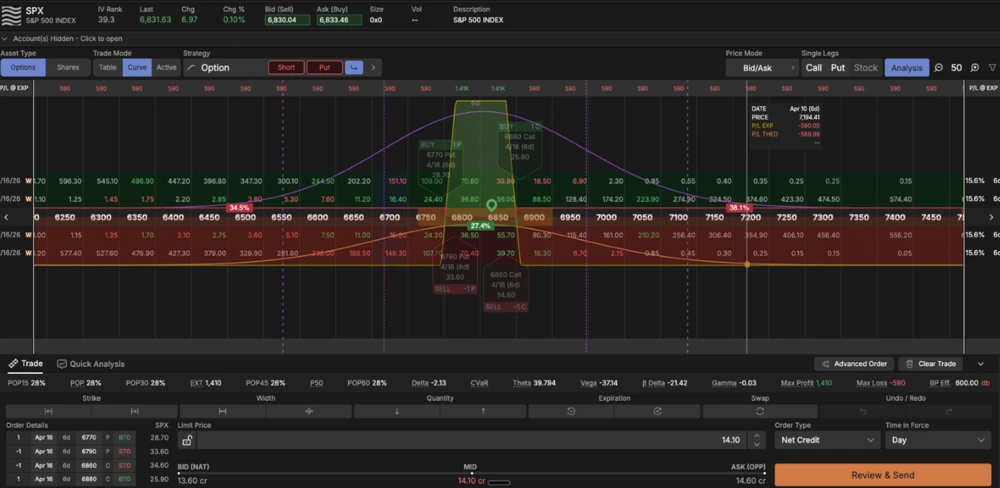
Short Iron Condor vs. Long Iron Condor
The strategy described on this page is the short iron condor. The trader sells both spreads and opens the position for a net credit, profiting if the underlying stays between the short strikes. This is what most traders mean when they say "iron condor."
The long iron condor is commonly used to describe the reverse structure, where both spreads are bought for a net debit and the position profits when the underlying moves outside the strikes. Unless stated otherwise, "iron condor" on this page refers to the short iron condor.
Iron Condor Construction
Here is the iron condor options strategy explained one leg at a time. Every iron condor has two spread components:
Short call vertical spread (bearish side)
- Sell an OTM call at a higher strike than the current price
- Buy a further OTM call to cap upside risk
Short put vertical spread (bullish side)
- Sell an OTM put at a lower strike than the current price
- Buy a further OTM put to cap downside risk
Both spreads share the same expiration. The distance between the short and long strikes on each side is the spread width. Both spreads are typically the same width, though they do not have to be. The trade opens for a net credit, which is the sum of both spread credits.The iron condor spread is therefore two vertical spreads opened as a single position for one net credit.
Those two long strikes are what separate an iron condor from a naked strangle. Buying the wings (the long strikes) costs part of the credit. In exchange, the worst case becomes defined, which is why buying power requirements are lower than on an equivalent undefined-risk position. Buying power is the maintenance requirement your broker sets aside while the trade is open.
tastytrade displays the probability of profit (POP) natively on every position, making it straightforward to evaluate the statistical likelihood of a given setup at a glance. Probability of profit is a mathematical estimate based on the options market's pricing at a given moment and does not guarantee any outcome.
Iron Condor Example
The following is a hypothetical illustration of mathematical principles. It does not predict or project the performance of any investment or investment strategy and is not a recommendation to buy or sell any security.
TSTY is trading at $175.
Leg | Strike | Action | Premium |
|---|---|---|---|
Short call | 190 | Sell | +$2.00 |
Long call | 195 | Buy | −$0.50 |
Short put | 160 | Sell | +$2.25 |
Long put | 155 | Buy | −$0.75 |
Leg | Strike |
|---|---|
Short call | 190 |
Long call | 195 |
Short put | 160 |
Long put | 155 |
Leg | Action |
|---|---|
Short call | Sell |
Long call | Buy |
Short put | Sell |
Long put | Buy |
Leg | Premium |
|---|---|
Short call | +$2.00 |
Long call | −$0.50 |
Short put | +$2.25 |
Long put | −$0.75 |
Call spread credit: $1.50 ($150)
Put spread credit: $1.50 ($150)
Total credit collected: $3.00 ($300)
Factor | Calculation | Result |
|---|---|---|
Max Profit | Total credit collected | $300 |
Max Loss (call side) | (Spread width − total credit) × 100 | ($5.00 − $3.00) × 100 = −$200 |
Max Loss (put side) | (Spread width − total credit) × 100 | ($5.00 − $3.00) × 100 = −$200 |
Upside Breakeven | Short call strike + total credit | $190 + $3.00 = $193 |
Downside Breakeven | Short put strike − total credit | $160 − $3.00 = $157 |
Factor | Calculation |
|---|---|
Max Profit | Total credit collected |
Max Loss (call side) | (Spread width − total credit) × 100 |
Max Loss (put side) | (Spread width − total credit) × 100 |
Upside Breakeven | Short call strike + total credit |
Downside Breakeven | Short put strike − total credit |
Factor | Result |
|---|---|
Max Profit | $300 |
Max Loss (call side) | ($5.00 − $3.00) × 100 = −$200 |
Max Loss (put side) | ($5.00 − $3.00) × 100 = −$200 |
Upside Breakeven | $190 + $3.00 = $193 |
Downside Breakeven | $160 − $3.00 = $157 |
When the spreads have different widths, max loss is calculated using the wider spread. The long options on each side cap the loss at a defined amount. This is what makes the iron condor a defined-risk strategy.
Multi-leg option strategies incur higher transaction costs as they involve multiple commission charges. See tastytrade pricing and fees for a full breakdown.
Iron Condor Profit and Loss
The maximum profit equals the total net credit collected when opening the position. This occurs if every option expires worthless.
Maximum loss equals the width of the wider spread minus the credit collected.
In the TSTY example that is $5.00 minus $3.00, or $200 per contract.
If both sides are the same width, the loss is identical whether the stock runs up through the calls or down through the puts. Either direction, the long option on that side defines the max loss.
Breakevens at expiration:
- Upside: Short call strike + total credit received
- Downside: Short put strike − total credit received
Prior to expiration, the position can be closed for a profit if the condor can be purchased for a debit less than the original credit. Closing early removes all remaining risk, including the risk of the underlying reversing back through the profit zone before expiration.
When Traders Use the Iron Condor Strategy
The iron condor is a directionally neutral strategy. Traders who use the iron condor strategy typically do so when:
Implied volatility (IV) is higher than their individual outlook for the stock
They expect the underlying to trade sideways or stay within a defined range for a period of time
Iron condor options are available in IRA accounts at tastytrade, where the defined-risk structure carries a lower buying power requirement than an undefined-risk equivalent.
Greeks Profile
Iron condor options carry a distinct Greek profile that drives the mechanics of the position:
Theta (time decay): Positive. The position gains value each day, all things being equal, as the options decay toward zero. Time decay is the primary source of profit in the iron condor.
Delta: Near zero at initiation when the short strikes are placed equidistant from the current price. The position develops directional exposure if the underlying moves toward one of the short strikes.
Vega: Negative. The position loses value when implied volatility expands and gains when IV contracts. This is why many traders prefer entering condors in higher-IV environments, where a subsequent contraction in IV can accelerate the decay of both spreads.
Gamma: Negative. Short gamma means losses accelerate when the underlying makes a sharp move in either direction. Gamma risk is highest in the days immediately before expiration.
Advantages and Disadvantages of an Iron Condor
Every feature of an iron condor cuts both ways. The wings that cap the loss also cap the credit, and the theta that pays the position also means time is the only thing working in its favor.
The practical read is that iron condor options suit traders who are comfortable trading probability rather than direction and who will actually manage the position rather than hold it to expiration.
Advantages and Disadvantages of an Iron Condor
Advantages | Disadvantages |
|---|---|
Maximum loss is defined and known before entry | Maximum profit is capped at the credit received |
Lower buying power requirement than an undefined-risk equivalent | Max loss exceeds max profit at typical credit levels, so a single loser can undo several winners |
Positive theta, so the position gains as time passes | Four legs means four commissions and four bid/ask spreads to cross |
Profits from sideways action, not just a correct direction | Short gamma, so losses accelerate on a sharp move in either direction |
Short vega, so a contraction in implied volatility helps | Needs a range. A trending or gapping underlying works against it |
Available in IRAs at tastytrade | Equity options carry assignment risk if a short strike finishes ITM |
Advantages | Disadvantages |
|---|---|
Maximum loss is defined and known before entry | Maximum profit is capped at the credit received |
Lower buying power requirement than an undefined-risk equivalent | Max loss exceeds max profit at typical credit levels, so a single loser can undo several winners |
Positive theta, so the position gains as time passes | Four legs means four commissions and four bid/ask spreads to cross |
Profits from sideways action, not just a correct direction | Short gamma, so losses accelerate on a sharp move in either direction |
Short vega, so a contraction in implied volatility helps | Needs a range. A trending or gapping underlying works against it |
Available in IRAs at tastytrade | Equity options carry assignment risk if a short strike finishes ITM |
Iron Condor Adjustment Strategies
Iron condor adjustment strategies commonly take the following forms. Position management decisions depend on individual risk tolerance, account size, and objectives. The approaches below illustrate common techniques and are not recommendations.
Closing for a profit target: One common approach is placing a good till canceled (GTC) order to close the position after reaching a specific profit threshold, such as 50% of the original credit. For example, a $3.00 credit condor could be closed at a $1.50 debit. Closing early removes all remaining risk in exchange for giving up any remaining potential profit.
Managing the untested side: When the underlying moves toward one short strike, the opposite spread often loses most of its value. Closing the untested side for a small debit reduces the remaining position to a single short vertical spread.
Rolling a threatened spread: Rolling means closing a spread and reopening it at different strikes or in a later expiration cycle. This can collect additional credit and move the short strike farther out of the money, but it also extends the trade and may increase buying power requirements.
Closing at a loss: If the underlying moves through a short strike and the spread becomes deep ITM, closing the full position may limit the realized loss below the maximum possible loss at expiration. Many traders define a maximum acceptable loss before entering the trade.
Each adjustment adds transaction costs and changes the original risk profile. Rolling, in particular, extends the trade rather than simply managing the existing position.
Expiration Risk
A defined-risk spread is only defined risk if both legs settle the same way at expiration. The risk specific to expiration is called assignment risk: the short strike finishes in the money while the long strike finishes out of the money, leaving the short option subject to automatic exercise with no offsetting long option.
Options that expire in the money by $0.01 or more are automatically exercised by the OCC under its exercise-by-exception procedure, described in Characteristics and Risks of Standardized Options. If the short put expires ITM, it is assigned and converts to 100 long shares of stock per contract. If the short call expires ITM, it converts to 100 short shares. In either case, the position is no longer flat. It carries overnight directional stock risk into the next trading session.
After-hours risk also applies. An option that appeared to be OTM at the 4:00 p.m. ET closing print can become ITM based on after-hours price movement. The standard OCC exercise deadline is 5:30 p.m. ET. A sharp post-close move can result in an unexpected assignment even after the regular session close.
There is also pin risk: the underlying closes almost exactly at a short strike, leaving the trader unsure whether that option will be assigned. Closing an iron condor before expiration is the only way to eliminate both pin risk and assignment risk.
Iron Condor vs. Related Strategies
The iron condor belongs to a family of defined-risk premium-selling structures. The differences between related strategies involve the trade-off between credit collected and range of profitability.
Iron Condor vs. Iron Butterfly
An iron butterfly sells the call and put at the same at-the-money strike rather than at separate OTM strikes. It collects a larger credit but has a much narrower max profit range, essentially requiring the underlying to close very near a single price at expiration. The iron condor accepts a smaller credit in exchange for a wider max profit zone between the two short strikes. Choosing between an iron condor vs. iron butterfly comes down to whether you want a bigger credit or a bigger target.
Iron Condor vs. Strangle
A strangle sells a naked OTM call and OTM put with no long-option protection. It collects more credit and benefits from a wider range of profitability compared to the iron condor, but it is an undefined-risk position. The iron condor adds long wings to cap maximum loss. The trade-off is a smaller credit in exchange for defined risk.
Iron Condor vs. Short Call Spread or Short Put Spread
Each vertical spread is one half of an iron condor. Traders with a moderately directional view may prefer a single spread. The iron condor combines both for a fully neutral position.
Iron Condor vs. Related Strategies
Strategy | Risk Profile | Credit Collected | Max Profit Range | Best Case |
|---|---|---|---|---|
Iron Condor | Defined | Moderate | Wide band between two short strikes | Underlying stays between both short strikes |
Iron Butterfly | Defined | Larger than the Condor | Narrow, centered on one strike | Underlying pins in the shared short strikes |
Short Strangle | Undefined | Highest | Widest, no wings | Underlying stays between both short strikes |
Short Vertical Spread | Defined | Smallest | One direction only | Underlying moves away from the strikes |
Strategy | Risk Profile |
|---|---|
Iron Condor | Defined |
Iron Butterfly | Defined |
Short Strangle | Undefined |
Short Vertical Spread | Defined |
Strategy | Credit Collected |
|---|---|
Iron Condor | Moderate |
Iron Butterfly | Larger than the Condor |
Short Strangle | Highest |
Short Vertical Spread | Smallest |
Strategy | Max Profit Range |
|---|---|
Iron Condor | Wide band between two short strikes |
Iron Butterfly | Narrow, centered on one strike |
Short Strangle | Widest, no wings |
Short Vertical Spread | One direction only |
Strategy | Best Case |
|---|---|
Iron Condor | Underlying stays between both short strikes |
Iron Butterfly | Underlying pins in the shared short strikes |
Short Strangle | Underlying stays between both short strikes |
Short Vertical Spread | Underlying moves away from the strikes |
Iron Condor on Index Options
Index options are used by experienced traders for several structural reasons worth understanding:
Section 1256 tax treatment. Index options that qualify as Section 1256 contracts receive blended capital gains treatment. 60% long-term and 40% short-term, regardless of the holding period. Traders should consult a qualified tax professional regarding their individual tax situation. tastytrade does not provide tax advice.
Cash settlement. Index options settle in cash rather than in shares. This means a short option that expires in the money results in a cash debit or credit rather than a stock position. Cash settlement eliminates the risk scenario of a spread converting into shares at expiration.
Liquidity. Some index option markets are deep, which matters when four legs of an iron condor options position have to be filled and later closed.
Placing an iron condor trade on tastytrade builds all four legs as a single order rather than four separate tickets, so iron condor options are priced and filled as one position.
Open the option chain for the underlying and select the expiration cycle you want to trade.
Switch the chain to the iron condor curve so the four legs populate together.
Choose the short call and short put strikes. These set the profit range and the probability of profit.
Choose the wing width. Wider wings collect more credit and carry a larger max loss. Narrower wings do the reverse.
Review the trade page for credit received, max profit, max loss, breakevens, POP, and buying power effect.
Send the order as a limit order at or near the mid price, which sits halfway between the bid and the ask. Four-leg orders rarely fill at the natural price, the worst price on the quote.
After the fill, set a good-till-canceled closing order if you plan to manage the position at a profit target.
Key Takeaways
The iron condor trades a capped profit for a defined maximum loss that is known before entry.
At typical credit levels the maximum loss is larger than the maximum profit, so sizing and management matter more than win rate.
The position needs a range. A trending or gapping underlying works against it in either direction.
Higher implied volatility at entry increases the credit collected, and a later contraction in IV generally helps the position.
Most of what determines the outcome happens after entry: profit targets, managing the untested side, rolling, and closing at a loss.
Holding to expiration introduces assignment and pin risk that closing early avoids.
Frequently Asked Questions
The maximum profit on an iron condor equals the total net credit received when the position was opened. It is achieved when all four options expire out of the money and worthless. The full credit is retained. Max profit is only realized if the underlying closes between the two short strikes at expiration.
Maximum loss equals the width of the wider spread minus the total net credit received. For example, a $5-wide condor opened for a $3.00 credit has a maximum loss of $2.00 per share, or $200 per contract. The long options on each side cap the loss. The position cannot lose more than this defined amount regardless of how far the underlying moves if a spread expires fully ITM.
There are two breakeven prices at expiration. The upside breakeven equals the short call strike plus the total credit received. The downside breakeven equals the short put strike minus the total credit received. The position is profitable at expiration if the underlying closes between these two prices. Breakeven calculations apply at expiration only; prior to expiration, the position value is affected by implied volatility, time remaining, and the underlying price.
There is no universal answer. The decision depends on individual risk tolerance, account objectives, and how the position has moved. Some traders set a profit target at a percentage of the original credit and use a GTC order to close automatically when that level is reached. Others close when a loss threshold is exceeded. Closing early removes all remaining risk and eliminates exposure to expiration risk.
Yes. Iron condors are available in IRA accounts at tastytrade, subject to account approval and the options trading permissions on the account. Because both spreads are defined-risk, the maximum loss is known at entry and the buying power requirement is lower than on an undefined-risk equivalent. Account approval is required and not guaranteed.
The four most common adjustment strategies for iron condor options are closing at a profit target such as a percentage of the original credit, closing the untested side once it has lost most of its value, rolling the threatened spread further out of the money or out in time to collect additional credit, and closing the whole position at a pre-defined loss threshold. Each adjustment adds transaction costs and changes the original risk profile, and none guarantees a better outcome than simply closing the trade.
Iron condor probability of profit depends entirely on where the short strikes sit. Short strikes closer to the money produce a larger credit and a lower probability of profit. Short strikes further out do the reverse. Because of that, there is no single win rate for iron condor options that holds across underlyings, durations, and strike widths. tastytrade displays probability of profit on every position so the estimate is visible before the order is sent. POP is a mathematical estimate derived from current option pricing and does not guarantee any outcome.
Options involve risk and are not suitable for all investors as the special risks inherent to options trading may expose investors to potentially significant losses. Please read Characteristics and Risks of Standardized Options before deciding to invest in options.
All investments involve risk of loss. Please carefully consider the risks associated with your investments and if such trading is suitable for you before deciding to trade certain products or strategies. You are solely responsible for making your investment and trading decisions and for evaluating the risks associated with your investments.
Multi-leg option strategies incur higher transaction costs as they involve multiple commission charges.