


Grain futures are CME-listed contracts covering corn, soybeans, and wheat — three of the most actively traded agricultural commodities in the world. Each standard contract controls 5,000 bushels and trades on a distinct seasonal schedule tied to planting and harvest cycles. This article covers contract specifications, trading hours, price drivers, expiration mechanics, and how to execute grain futures trades on tastytrade.
Grain futures are exchange-listed derivatives contracts that give traders exposure to the price of corn, soybeans, and wheat without owning the physical commodity. Each contract is standardized—fixed contract size, tick value, and expiration schedule—and trades on the CME Group's CBOT (Chicago Board of Trade) exchange. tastytrade offers access to all three standard grain futures and their mini-sized equivalents through its futures trading platform.
Grain futures are physically deliverable contracts, which means positions held through the first notice date can result in an obligation to take or make delivery of the underlying commodity. tastytrade does not support physical delivery, which means traders must roll or close positions before the first notice date.
Grain Futures Contract Specifications
The three primary grain futures—corn (/ZC), soybeans (/ZS), and Chicago SRW wheat (/ZW)—share the same contract size and tick structure.
Product | Size | Tick | Settlement | Available Options |
|---|---|---|---|---|
/ZC - Corn | 5,000 bushels | 0.25 = $12.50 | Deliverable | Yes |
/ZS - Soybeans | 5,000 bushels | 0.25 = $12.50 | Deliverable | Yes |
/ZW - Chicago SRW Wheat | 5,000 bushels | 0.25 = $12.50 | Deliverable | Yes |
Product | Size |
|---|---|
/ZC - Corn | 5,000 bushels |
/ZS - Soybeans | 5,000 bushels |
/ZW - Chicago SRW Wheat | 5,000 bushels |
Product | Tick |
|---|---|
/ZC - Corn | 0.25 = $12.50 |
/ZS - Soybeans | 0.25 = $12.50 |
/ZW - Chicago SRW Wheat | 0.25 = $12.50 |
Product | Settlement |
|---|---|
/ZC - Corn | Deliverable |
/ZS - Soybeans | Deliverable |
/ZW - Chicago SRW Wheat | Deliverable |
Product | Available Options |
|---|---|
/ZC - Corn | Yes |
/ZS - Soybeans | Yes |
/ZW - Chicago SRW Wheat | Yes |
Mini Grain Futures
Mini contracts can be less liquid than standard contracts, particularly during off-peak hours, so its important to check volume and open interest before entering a position. Avoid placing large orders at market when liquidity is thin, as thin liquidity can make it difficult to get out of your position.
Product | Size | Tick | Settlement | Available Options |
|---|---|---|---|---|
/MZC - Micro Corn | 500 bushels | 0.05 = $2.50 | Financially | No |
/XC - Mini Corn | 1,000 bushels | 0.125 = $1.25 | Deliverable | No |
/MZS - Micro Soybean | 500 bushels | 0.05 = $2.50 | Financially | No |
/XK - Mini Soybean | 1,000 bushels | 0.125 = $1.25 | Deliverable | No |
/MZL - Micro Soybean Oil | 6,000 pounds | 0.0002 = $1.20 | Financially | No |
/MZM - Micro Soybean Meal | 10 short tons | 0.2 = $2.00 | Financially | No |
/XW - Mini Chicago SRW Wheat | 1,000 bushels | 0.125 = $1.25 | Deliverable | No |
/MZW - Micro Wheat | 500 bushels | 0.05 = $2.50 | Financially | No |
Product | Size |
|---|---|
/MZC - Micro Corn | 500 bushels |
/XC - Mini Corn | 1,000 bushels |
/MZS - Micro Soybean | 500 bushels |
/XK - Mini Soybean | 1,000 bushels |
/MZL - Micro Soybean Oil | 6,000 pounds |
/MZM - Micro Soybean Meal | 10 short tons |
/XW - Mini Chicago SRW Wheat | 1,000 bushels |
/MZW - Micro Wheat | 500 bushels |
Product | Tick |
|---|---|
/MZC - Micro Corn | 0.05 = $2.50 |
/XC - Mini Corn | 0.125 = $1.25 |
/MZS - Micro Soybean | 0.05 = $2.50 |
/XK - Mini Soybean | 0.125 = $1.25 |
/MZL - Micro Soybean Oil | 0.0002 = $1.20 |
/MZM - Micro Soybean Meal | 0.2 = $2.00 |
/XW - Mini Chicago SRW Wheat | 0.125 = $1.25 |
/MZW - Micro Wheat | 0.05 = $2.50 |
Product | Settlement |
|---|---|
/MZC - Micro Corn | Financially |
/XC - Mini Corn | Deliverable |
/MZS - Micro Soybean | Financially |
/XK - Mini Soybean | Deliverable |
/MZL - Micro Soybean Oil | Financially |
/MZM - Micro Soybean Meal | Financially |
/XW - Mini Chicago SRW Wheat | Deliverable |
/MZW - Micro Wheat | Financially |
Product | Available Options |
|---|---|
/MZC - Micro Corn | No |
/XC - Mini Corn | No |
/MZS - Micro Soybean | No |
/XK - Mini Soybean | No |
/MZL - Micro Soybean Oil | No |
/MZM - Micro Soybean Meal | No |
/XW - Mini Chicago SRW Wheat | No |
/MZW - Micro Wheat | No |
Trading Hours
Grain futures trade on a different schedule than equity index futures. This is one of the most common points of confusion for traders new to agricultural markets.
Standard grain futures trading hours (Central Time):
- Overnight session (Sunday – Friday): 7:00 PM – 7:45 AM CT
- Day session (Monday – Friday): 8:30 AM – 1:20 PM CT
There is a 45-minute break from 7:45 AM to 8:30 AM CT on trading days. Markets are closed from 1:20 PM to 7:00 PM CT. These hours apply to /ZC, /ZS, /ZW, and their mini equivalents. Verify current trading hours through the tastytrade platform or CME Group directly, as exchange hours are subject to change around holidays.
Expiration Schedule and Contract Months
Grain futures follow a seasonal expiration schedule tied to crop cycles, and not all months are listed for all products.
Corn (/ZC) contract months: March (H), May (K), July (N), September (U), December (Z)
Soybean (/ZS) contract months: January (F), March (H), May (K), July (N), August (Q), September (U), November (X)
Wheat (/ZW) contract months: March (H), May (K), July (N), September (U), December (Z)
The distinction between old crop and new crop months matters for spread traders. Old crop contracts represent grain from the current harvest year; new crop contracts represent the anticipated harvest from the next planting cycle. The price relationship between old and new crop months reflects supply expectations, storage costs, and weather risk.
Positions must be closed or rolled before the first notice date. tastytrade sends a first notice date alert ahead of time. Failure to act before the first notice date can result in position liquidation by the firm.
What Drives Grain Futures Prices
Grain prices respond to a distinct set of fundamental factors that differ from equity or index futures. Key drivers include:
USDA Reports
Two reports move grain markets more than any other: the World Agricultural Supply and Demand Estimates (WASDE), published monthly, and the Prospective Plantings report, published in late March. These reports can produce sharp intraday moves in /ZC, /ZS, and /ZW. Traders typically avoid holding these releases if they are not comfortable with the associated risk.
Weather
Drought, flooding, and frost at critical growth stages — particularly pollination for corn and pod fill for soybeans — affect yield estimates directly. Weather markets tend to develop in June and July in the United States.
Export Demand
The US is a major grain exporter. Weekly export inspection data and the USDA's export sales report provide signals on foreign demand, particularly from China, Mexico, and Egypt. A surge in Chinese soybean purchases can move /ZS meaningfully.
Currency
A stronger US dollar makes US grain more expensive for foreign buyers and can suppress demand. The relationship between grain prices and the dollar is not always tight, but it is a background variable worth tracking for longer-duration positions.
Energy Prices
Corn has a direct link to energy markets through ethanol. Higher crude oil prices tend to increase ethanol demand, which supports corn prices.
Carry and Spread Structure
When front-month prices trade above deferred months, the market is in “backwardation.” When deferred months are higher, the market is in “contango” (normal carry). The spread structure between contract months signals storage economics and market expectations for future supply.
Strategies for Grain Futures
Outright Futures Positions
A directional trade in a single contract month. Long /ZC is a bet that corn prices will rise; short /ZS is a bet that soybean prices will fall. Outright positions carry the full delta of the contract. A $0.10/bushel move in corn equals a $500 move in a /ZC contract. Position sizing should account for the distance to the stop or exit, not just the margin requirement.
Calendar Spreads
A calendar spread involves buying one contract month and selling another in the same underlying. For example, long /ZC December and short /ZC March. Calendar spreads reduce outright price exposure and express a view on the relationship between old and new crop, or between nearby and deferred supply.
Grain Pairs
Corn–soybean and corn–wheat pairs express a relative value view. The corn–soybean ratio (the price of soybeans divided by the price of corn) is a widely tracked metric that affects planting decisions. When beans are expensive relative to corn, farmers plant more beans. When the ratio compresses, corn acreage increases. Pairs trades go long the relatively cheap grain and short the relatively expensive one.
Futures Options on Grains
tastytrade offers options on grain futures, including options on /ZC, /ZS, and /ZW (but not on the micro-contracts). Futures options settle to the underlying futures contract, not cash. Strategies like short strangles and vertical spreads around USDA report dates are common approaches for traders who want defined or manageable risk exposure to grain volatility.
Futures options on grains at tastytrade are priced at $1.25 per contract to open and $1.25 to close. See the full pricing and fees page for current rates.
Physical Delivery and First Notice Date
Grain futures are physically deliverable. Unlike cash-settled contracts like /ES or /NQ, holding a grain futures contract through delivery can result in an obligation to receive or deliver thousands of bushels of grain. As a result, tastytrade does not support physical delivery. Instead, tastytrade requires you to close your position or roll it to the next futures contract by the first notice date. This date is the first day a delivery notice can be issued against a long futures position. For most grain contracts, this falls near the end of the month prior to expiration. tastytrade will send first notice date reminders and may liquidate positions that approach delivery if not addressed. Traders should build position management rules around first notice dates, not expiration dates, when trading grains.
Trading Grain Futures on tastytrade
tastytrade's platform supports grain futures trading through the desktop platform and Active Trader interface. The Active Trader interface provides a ladder-style order entry tool suited to active futures traders.
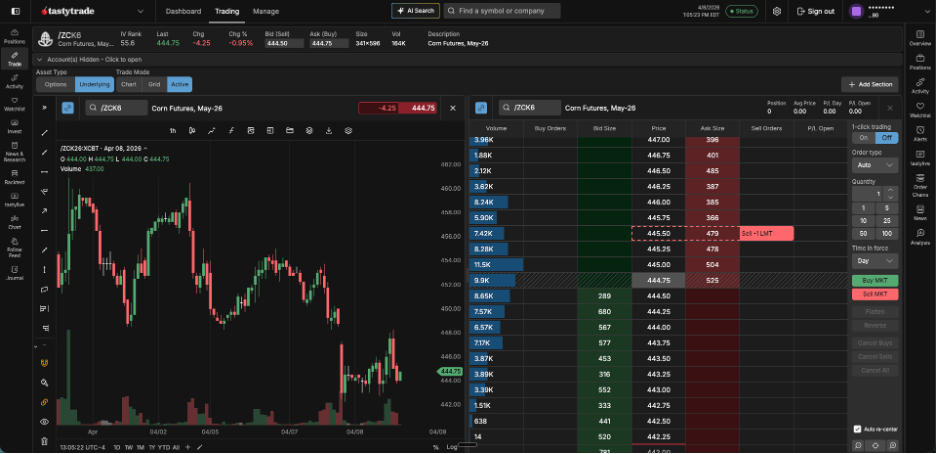
To execute a grain futures trade:
- Navigate to the Trade tab and search for the contract symbol (/ZC, /ZS, or /ZW followed by the expiration code—e.g., /ZCN6 for July corn)
- Select the desired expiration month
- Choose Futures in the instrument type selector
- Enter the quantity and order type (limit orders are strongly preferred over market orders in grain futures, given potential spread width)
- Review the margin requirement at Review & Send
- Confirm and submit
There is no minimum account balance to trade CME futures in a margin account. For IRA accounts, start-of-day net liquidation must be $25,000 for standard futures contracts.
Grain Futures vs. Grain ETFs
Traders who want grain exposure without holding futures contracts can use commodity ETFs such as CORN (ProShares Corn ETF) or SOYB (Teucrium Soybean Fund). ETFs eliminate first notice date management and are available in standard brokerage accounts. However, ETFs carry expense ratios, may not track spot prices precisely due to roll costs, and do not provide the leverage or capital efficiency of direct futures exposure.
Futures can provide clean exposure to grain prices, favorable margin efficiency, and tax treatment under Section 1256 (60% long-term / 40% short-term capital gains regardless of holding period). The tradeoff is contract size risk and the obligation to manage first notice dates. For more on trading commodity-linked products, see the commodities overview.
FAQs
The three primary grain futures traded on the CME Group's CBOT exchange are corn (/ZC), soybeans (/ZS), and Chicago SRW wheat (/ZW).
Each standard contract controls 5,000 bushels. tastytrade offers access to all three, plus their mini-sized equivalents (/XC, /XK, /XW) at one-fifth the contract size.
Grain futures trade in two sessions on CME Globex: the night trading session runs overnight from 7:00 PM CT through 7:45AM CT Sunday-Friday with the primary (day) session running from 8:30 AM CT to 1:20 PM CT Monday-Friday. There is a 45-minute break between sessions each trading day. These hours differ from equity index futures, which trade 23 hours everyday Sunday at 5:00 PM CT through Friday at 4:00PM CT.
All three standard grain futures share the same tick structure. The minimum price increment is ¼ cent per bushel, which equals $12.50 per contract (¼ cent × 5,000 bushels). Mini contracts have a tick size of ⅛ cent per bushel, equal to $1.25 per contract.
The first notice date is the first day a delivery notice can be issued against a long grain futures position. For most CBOT grain contracts, this falls near the end of the month preceding expiration. Since tastytrade does not support physical delivery, positions must be closed or rolled before the first notice date. tastytrade sends automated alerts ahead of this deadline.
Grain futures traded on US exchanges are Section 1256 contracts. Section 1256 contracts receive blended capital gains treatment: 60% of gains and losses are treated as long-term, and 40% as short-term, regardless of how long the position was held. This treatment applies to /ZC, /ZS, and /ZW futures. Consult a tax professional for guidance specific to your situation.
Yes. tastytrade supports futures trading in IRA accounts. Start-of-day net liquidation must be $25,000 for standard CME futures contracts. For mini futures contracts, the requirement is $5,000. Physical delivery is not permitted in any account type at tastytrade, including IRAs.
This content, including the use of actual symbols, any visual display or other reference to product, type of investment, strategy, or service offered, is for educational purposes only. It is not, nor is intended to be, trading or investment advice or a recommendation that any investment product or strategy is suitable for any person. You are solely responsible for making your own investment and trading decisions and for evaluating relevant factors, including their investment experience, objectives, financial situation, and risk tolerance prior to trading.
Futures accounts are not protected by the Securities Investor Protection Corporation (SIPC). All customer futures accounts' positions and cash balances are segregated by Apex Clearing Corporation. Futures and futures options trading is speculative and is not suitable for all investors. Please read the Futures & Exchange-Traded Options Risk Disclosure Statement prior to trading futures products.
Investors should obtain a copy of the investment company’s prospectus, which contains important information about the investment company, related risks, and expenses. Carefully read the prospectus before investing in an ETF.